


Author:
Expert
Mastering the Greens: A Deep Dive into Golf Course Putting Speeds and Stimpmeters
13 October 20237 min. readJeroen Korving
Every golfer loves good greens. They need to be fair and they need to be consistent in terms of speed. If every green is similar or uniform, it makes putting more predictable and golfers like that. The speed of a green is measured by a Stimpmeter and in this article we'll explain everything you need to know about the stimp of a green.
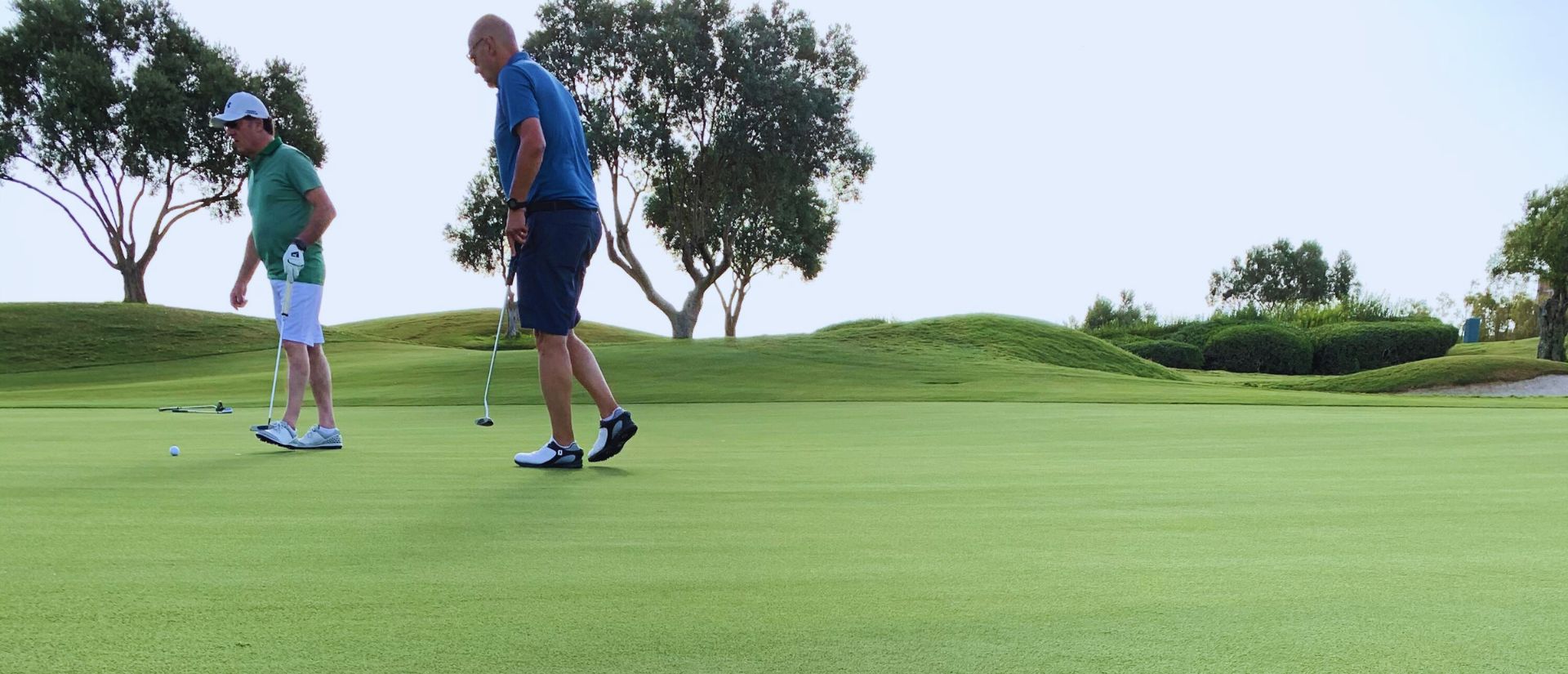
Immaculate greens at Finca Cortesín in Spain (photo credits: Leading Courses)
In the 1930s a guy named Edward Stimpson - who happened to be the Amateur Champion of Massachusetts - wondered if some greens were faster than others and if there was a difference per course. Knowing this would give a player a considerable competitive advantage on the course. Stimpson created the first Stimpmeter in the 1930s mainly out of curiosity. The concept of the Stimpmeter is to achieve accurate, objective, and valid information on putting green speeds.
The Stimpmeter
The Stimpmeter is a device used to measure the speed of a golf course putting green by applying a known velocity to a golf ball and measuring the distance traveled in feet. The device is an angled track with a v-shape groove in the middle to allow the ball to roll down in a consistent and repetitive manner. When it is raised to approximately 20 degrees from the putting surface the golf ball is released. The original Stimpmeter was made out of wood, but in 1976 it was redesigned from aluminum by Frank Thomas who worked at the USGA. The distance travelled by the ball in feet is the 'speed' or stimp of the putting green. So, if the stimp of a green is 8 it means the ball on average will roll 8 feet.
How should a Stimpmeter be used?
In order to measure the speed of a green you'll need the following equipment:
- a Stimpmeter
- three golf balls
- three tees
- 12- or 15-foot measuring tape
- a data sheet

Measuring the stimp during the Ladies Open at The International in The Netherlands (photo credits: Leonard)
To measure the speed of a green, you need to follow a few predefined steps.
1. Select a level area on the green, approximately several feet wide and 10 to 12 feet in one direction.
2. Insert a tee in the green at one end of the level area to serve as a starting point. Then rest the tapered end of the Stimpmeter on the ground beside the tee, and aim it in the direction you intend to roll the ball.
3. Repeat the same procedure with two more balls, keeping the tapered end on the same spot. All three balls should come to rest not more than 8 inches apart. If this is not the case, then the process needs to be repeated.
4. Assuming the balls have stopped within the 8-inch limit, insert a second tee in the green at their average stopping point. The distance between the two tees is the length of the first series of rolls.
5. Repeat the process of rolling 3 golf balls down the Stimpmeter along the same line, but now in the opposite direction.
6. If the balls are within 8-inches from each other, measure the distance in feet and calculate the average of the two. This is the speed of the green.
If the difference in length between the first and second series is greater than 18 inches, then the accuracy of the resulting average is questionable. It is then wise to repeat the process, but then on a different level part of the green. Conditions during a test are pretty important. It's best to test your greens under perfect conditions, so a cleanly mowed, dry, smooth surface on a calm day.
Summarising, the resulting average of the two tests will give you the stimp and the amount in feet is the stimp. If you want to know all the ins and outs on how to use a Stimpmeter, then just check the site of the USGA.
When is a green fast?
In 1978 the USGA initiated the measurement of numerous golf courses across the United States. They assessed more than 2,000 golf courses and they determined that the average stimp was approximately 6.5. At that time, only 2% of golf courses boasted green speeds exceeding 9.0. Nowadays, a stimp of 7 or 8 is regarded as slow.
In general the stimp on European courses will be less than the stimp in the USA. This is also the case in professional tournaments. Greens during a European Tour event are generally between 10.5 and 11.5. For the Masters, US Open, The Players Championship and US PGA Championship, green speeds will often go upwards of 13. During the Ryder Cup 2023 at the Marco Simone Golf & Country Club Team Europe made the greens slower to utilise their home advantage and to throw the Americans off their game.
- Stimp 12 and higher: extremely fast greens and really only suitable for professional golfers. This would be the speed of greens during the PGA Tour. During the Masters the stimp might exceed 13, although you are not allowed to measure the speed of the greens at Augusta National.
- Stimp 11: fast greens, generally only suited for low handicap players
- Stimp 10: often the preferred speed at high-end golf clubs. The ball roll is true and fast but is still manageable for higher handicap golfers.
- Stimp 8 and 9: the speed of greens at commercial and public golf clubs. A stimp of 8 might already give golfers the feeling that a green is slow due to the longer and thicker leaves of the grass.
- Stimp lower than 8: these would be considered very slow greens and this will affect the experience golfers will have on the course. They most likely will rate 'maintenance' as low (below 6 out of 10).
The next time you hear someone say that the stimp of the greens is 11.5, now you know that you might need to adjust the stroke of your putter. And that this means a ball will roll 11 and a half feet, measured by a Stimpmeter.
Golf clubs with fast greens
The greens at Oakmont Country Club (where the Stimpmeter was conceived) are known to be very fast, generally between 12 and 15. Based on our own experience and reviews, this is where you should go to experience fast greens in Europe. Still, the speed of the greens highly depend on the season. If you play just after winter (when the grass is still hibernating), it's not possible for greenkeepers to provide fast greens. The grass needs to grow, before they can start cutting it short.
/521_1605711962.799.jpg?v1)
/521_1605711956.793.jpg?v1)
/521_1605711962.069.jpg?v1)
/521_1605711962.312.jpg?v1)
/521_1605711961.914.jpg?v1)

/441_1470820782.313.jpg?v1)
/441_1720191897.336.jpg?v1)
/441_1720191897.230.jpg?v1)
/441_1624887502.100.jpg?v1)
/441_1624870072.610.jpg?v1)
/328_1676282813.375.jpg?v1)
/328_1679679747.550.jpg?v1)
/328_1676282806.248.jpg?v1)
/328_1676282808.642.jpg?v1)
/328_1676282813.312.jpg?v1)
/10126_1673271150.239.jpg?v1)
/10126_1637766352.511.jpg?v1)
/10126_1637766352.656.jpg?v1)
/10126_1469604441.025.jpg?v1)
/10126_1325597338_1.jpg?v1)
/526_1510587492.931.jpg?v1)
/526_1565596038.429.jpg?v1)
/526_1565596027.172.jpg?v1)
/526_1565596017.111.jpg?v1)
/526_1565595938.259.jpg?v1)
Why greens perhaps shouldn't be too fast
Fast greens can be very impressive but they are not necessarily always good for golf. Average golfers already have quite some difficulty reaching the green in regulation. When they finally end up there and they need more than 3-putts on every green, they might not have the best time. Moreover, fast greens will also impact pace of play as golfers will need more shots (thus time) to finish the hole.
Maintaining fast greens also places significant pressure on both the golf course itself and its greenkeepers. When a club strives for or becomes known for their fast greens, there's a potential pitfall of becoming overly fixated on maintaining that reputation consistently. Trimming the grass too short increases the risk of damage, necessitating additional watering which compromises sustainability.
The reasons mentioned above - pace of play and additional costs - are the reason why you'll mainly find fast greens on the more high-end golf courses. They charge higher green fee prices and the tee time intervals are much longer - often 15 minutes compared to the 6-8 minute intervals on commercial golf courses.
About the author
Related articles


Find a golf region
Most popular spots for golf
Spain
Golf courses in BarcelonaGolf courses in MadridGolf courses in MarbellaGolf courses in MálagaGolf courses in SevilleFrance
Golf courses in CannesGolf courses in Cap d'AgdeGolf courses in Chamonix-Mont-BlancGolf courses in NiceGolf courses in ParisPortugal
Golf courses in AlbufeiraGolf courses in LagosGolf courses in LisbonGolf courses in PortimãoGolf courses in PortoItaly
Golf courses in FlorenceGolf courses in MilanGolf courses in NaplesGolf courses in RomeGolf courses in VeniceTop blogs


Copyright © 2007-2026 — leadingcourses.com